
HISTORY OF DAIMÚS
Daimus today
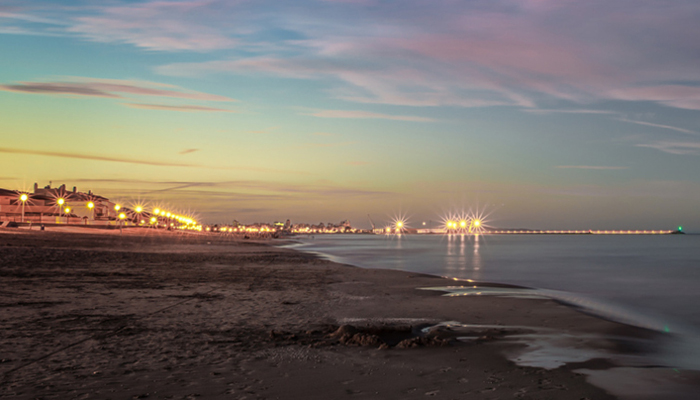
Daimús is a typically Mediterranean municipality, ideally located on the coast, with a mild climate, and a fine, peaceful and quiet beach with all the services that make it an undisputed destination for relaxing tourism, compared to other beaches in the area.
The municipal district of Daimús borders to the north with Gandia through the Rafalcaid section and the Serpis river. To the south with the municipality of Guardamar, to the east with the Mediterranean Sea and to the west with the municipality of Bellreguard through the royal road of Miramar, which passes next to the old Torre dels Pares.
The vast majority of the population resides in the urban center of Daimús, composed of the following neighborhoods: Nucli Antic, Camí al Mar, Platja, Els Pedregars, La Mingola, Les Casetes and Les Marines. It should be noted that during the summer period, its population increases considerably, reaching, in the month of August, approximately 20.000 inhabitants.
The mountainous cirque that embraces the area has an important climatological effect, because, associated with a rainfall regime that exceeds 750 liters per year, it protects the valley from frost and other inclement weather. The average annual temperature is higher than 19ºC.

History
Daimús, a place name of Arab origin, was one of the territories that depended on the castle of Bairén. In Roman times, a series of rustic villages were established in the slightly elevated areas, which protruded from the plains and marshes that formed the landscape, the remains of which, almost completely destroyed by the plantations of vineyards first and citrus fruits later, emerge as soon as something goes deeper into the ground.
The Roman settlement must have begun in the 54st century AD, as seems to indicate by the discovery of a silver denarius from the Acília family, from the year 82 BC, together with a bronze ace from Domitian from the year XNUMX AD, and it undoubtedly lasted until Muslim times, linking it with historical times.
Some remains from the Roman period are preserved, such as the site of the Hort del Comte and the tomb of Baebia Quieta, true treasures and relics of the municipality. In the case of the tomb, it was a citrus field on the surface of which Roman remains were found. Some hypotheses suggest that it was the city of Artemision. In 1506, marble heads appeared under a stone, one of a man and the other of a woman, in addition to two Roman tombstones, one of them in an old tower and the other in a tower-shaped tomb.
The Letter Puebla
Two emblematic references mark the History of Daimús, and both are represented in the municipal coat of arms with the tower in the first quarter divided and the Ferrer coat of arms in the third half-cut. Such references are: the Roman Mausoleum of Baebia Quieta of the first century of our era, which was an obvious sign of the first four hundred years of its History, and the Letter Puebla granted by Vicent Ferrer i Ros, VII Lord of Daimús, to the repopulators who filled the void left in this Lordship by the Moors expelled from Spain in 1609.
La Letter Puebla, which is now four hundred years old, is the birth certificate of the new Daimús born on July 15, 1612 under the socio-political structure of the Old Regime, which would give way to the First Spanish Magna Carta of March 19, 1812, which also celebrates the bicentennial of its promulgation this year.
The commemoration of such an important event, as was the awarding of our Letter Puebla, should not go unnoticed by those of us who form, today, the Daimusera community that those repopulators started.
In your hands you have a booklet with those XXIII Chapters that governed the lives of our ancestors. Read it with interest and desire and participate in the cultural and recreational events that have been organized to celebrate its IV Centenary.
Daimús, February 2012
Frances Pons i Moncho
Chronicler

Transcription of the Pobla Letter by Francesc Pons Moncho
In the transcription of this document, the original spelling has been respected, adding only the necessary orthographic signs to facilitate reading.
Chapters
Prime. The population of said place must be twenty households, distributed among twenty fields of orchard or more if the Lord so desires, and another twenty in the dry land and one olive grove day for each household.
II. We decree that each household must pay ten sous to the Lord every year on Christmas Day and a hen with the right of labor and sacrifice.
III. We decree that for each acre of garden or irrigated land they must pay six dollars, and for each acre of dry land, wooded or not, three dollars, and for marshland lands two dollars, all with the right of toil and rent each year within the said term.
III. We order that all fruit, both grain and vegetables and any other kind of crop that will come from said lands, must be divided, in the heirs the grain and in the terraces the other fruits according to the Lord's quarter, and the part corresponding to the Lord must be carried at their own expense to the Lord's house in said place and consequently the quarter of the wheat straw.
V. We must divide all fruit, such as oil, leaves, figs, and any other tree, into thirds, and the portion that belongs to the Lord must also be taken to the house of that person.
VI. We decree that the jury that will be elected and appointed by the Lord each year shall serve as a judge and shall take into account the law of the lands of said place, and that the fines and colonies shall be divided into three parts, that is, two parts for said official, and the third for the church building, and that such part shall be at the Lord's disposal.
VII. We decree that the penalties and colonies that said sewer must take and execute for the frauds and damages that they will cause in the sewer and water of that one must be in accordance with the use and practice of the town of Gandia and places of the garden of that one.
VIII. We order that the inhabitants of said place must attend to the necessary matters concerning the water of the river of said place for the part and portion that said place has in said water, that is, by having seaweed thrown into the well, draining and cultivating the blind marshes and drains of the marsh lands.
VIIII. We decree that since the said settlers wish to take out new lands in the marsh of said place in addition to those already taken out and having ditches made, that the Lord shall be obliged, at his expense, to make the ditches, and the said settlers the drains between them, and afterwards the said settlers shall keep the said ditches and drains, and that for the first four years they shall not be obliged to part with the Lord any kind of fruit from what they will do in said lands, except to pay the right to tithe.
X. We order that the olives, as they are harvested, must be brought to the Lord's house and oil mill for a penalty of twenty sous, and that the Lord must provide said oil mill with running water and grinding, and that, having paid the tithe, the said settlers must make the oil from the olives at their own expense, providing the Lord with a man and horse, paying the common grinding, according to the use of the oil mill, and, afterwards, part with the third with the Lord as stated, and that the stone and the remould belong to the Lord.
XI. We decree that when planting vineyards and fig trees in the dry lands, both for grapes and for wine, the first six years the fruit of those shall not be divided with the Lord. After which they shall be divided in the fourth year like the other grains and fruits of the land.
XII. We decree that pruning and cleaning olive trees or other trees must be done in accordance with the use and custom of a good farmer, notifying the Lord, and that the wood from the branch or twig must be for the Lord and for his trapig, and the twig for each lord of the respective inheritance, and that the Lord must have said wood from the branch removed at his own expense.
XIII. We order that in order to make any of the said partitions, they must notify the Lord on penalty of twenty sous, or the person he will appoint, but that with any of those they make the partitions of all the things that the Lord will have an interest in, and that in the other matters concerning the other officials of said place, only the Lord should interfere.
XIIII. Item that the seedlings of the sugar canes have the obligation of the Señor de conrrearios and at the time of planting to distribute the seedlings to the vassals.
XV. We decree that every year all the inhabitants of said twenty houses have the obligation to plant four hundred and fifty bushels of cane, which is the fifth part of the garden land they will have, and to give every year to the Lord three dozen bushels of cane on the day he wishes, giving the planting to the Lord and that the settlers have the obligation to plant every year two mulberry trees and two olive trees.
XVI. We order that each heir has the obligation to peel, dehull and throw his cane into the mill, and that the Lord has the obligation, afterwards, to make all the other necessary expenses in said mill and cane until sugar is made and put into the molds in the bank where it must be shared with the Lord, the heir paying the tithe of the sugar from his share that he will harvest, and that if the Lord wants to take a share, the heir can take another share for him so that no one has any grievance.
XVII. We order that in order to carry out the tasks of the mill to make said sugar, the Lord must provide the necessary people, paying the said people and workers at the price to each that the Duke of Gandia will pay in the mills of Gandia, and this respectively according to the stones that will be handled in each mill, and all the other expenses for equipment in said mill must be made by the Lord at his own expense.
XVIII. We order that the laborers who will be required to work in the mill and house of the Lord of the said place must help and do it in their shifts, as well as in preparing the said mill as in other tasks that will be offered between years or whenever the Lord wills, that is, in addition to the said works, four laborers per house on the Lord's lands each year, paying them for each laborer two Castilian reals, and a man and a woman four reals.
XVIII. Item that the Lord of said place appoints and appoints a guardian in that pear to guard the term and fruits of said place, and that the settlers and Lord must pay and establish a salary for said guardian.
XX. We decree that any of the settlers who will not make personal attendance for a period of four months in said place, incur, “ipso facto”, under penalty of confiscation of both the house and the lands, and that he cannot be excused from said personal residence, for any reason “cogitate or incogitate”, and that no one can sell any land or house under the same penalty, who has not first made personal residence in said place for a period of four years if the Lord has not already granted him a special license, and that the sale can only be made to a person who is obliged to the same personal residence and to the other agreements with which said settlement and the establishment of each of said houses and lands that must be sold are made.
XXI. We hereby declare that any heir who does not cultivate the lands to the use and habit of a good farmer, whether it is a garden or a dry land or a wooded area for a period of six months, the hour and the dry land for a year, incurs the penalty of confiscation “ipso facto”.
XXII. Ittem lo Señor reseva the Alfonsine Jurisdiction, that is, the one that according to the laws of the present Kingdom can exercise.
XXIII We decree that they may make two fanecadas of grass or hay for each household, paying only five sous per fanecada for all rights, and if they do not wish to do so they must request a license from said Lord and cannot do it in any other way.
The preceding Chapters were transcribed from a certain document of Capitulation, Settlement and Concord drafted and signed by En Vicent Ferrer i Ros, of the Order and Militia of the Virgin Mary of Montesa and Saint George of Alfama, and Lord of the place of Daimús, on the one hand; And on the other by the new settlers of said place, They were accepted by me, Pere Chela, notary, on the fifteenth day of July of one thousand six hundred and twelve, to whom full credibility must be given in all places: and so that there is no doubt, I sign with the manifestation of my salary and the customary seal of my notarial profession.